



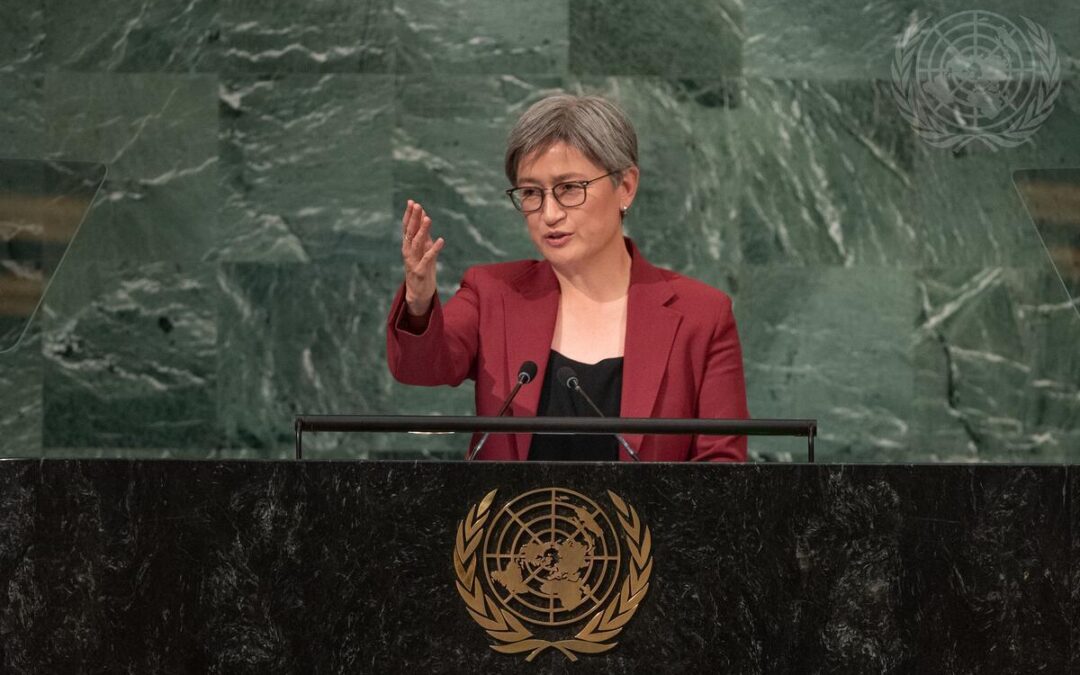
Foreign Minister Senator the Hon. Penny Wong at the United Nations General Assembly, 2022 (source: United Nations).
With everything going on this week, you would be forgiven for missing the United Nations Summit of the Future in New York. Countries by consensus adopted the Pact for the Future, a landmark document aimed at getting the United Nations Sustainable Development Goals and Paris Agreement back on track, reforming global governance, and building international peace and security.
The Pact was spearheaded by UN Security General António Guterres after stalled progress on stabilising warming to 1.5°C and mobilising climate finance at scale, as well as shared failures from the United Nations in resolving the now-protracted crises in Ukraine, Sudan and Gaza.
With existential challenges requiring unprecedented cooperation from the world’s governments, the international development sector hopes the Pact will be successful in its objective to turbocharge multilateralism.
ACFID was pleased to see Minister Wong’s speech at the Summit, in particular support from the Australian Government for reforming the UN system, leadership in developing a Declaration for the Protection of Humanitarian Personnel, and a new commitment to offer Climate Resilient Debt Clauses in sovereign loans – allowing countries to pause or defer repayments on Australian loans if hit by a climate-fueled disaster.
These are welcome, as was the Minister’s honest assessment of global stalling and regression on the achievement of the Sustainable Development Goals.
However, the Minister also looked to scrape a pass on the Pact’s commitments, claiming that “in so many ways, Australia is already delivering on the Pact for the Future”. The day after her speech, the Australian Government greenlit three coal mine expansion projects. This goes against the spirit of the Pact, which is designed to spur transformative action from UN Members.
In reality, Australia is under-delivering in several areas of the Pact, particularly on Action 9 to strengthen climate action.
In her speech, Minister Wong mentioned the signing of the Falepili Union treaty, and how it is a pivotal moment in Australian foreign-policy making. It is not enough that Australia has signed the Falepili Union to recognise Tuvalu’s continued sovereignty in the face of sea level rise – it must do everything it can to stop Pacific Islands from being swallowed by the ocean in the first place.
Australia must heed the calls of the Pacific to reduce its own emissions in line with 1.5°C, including ending government subsidies to fossil fuel companies and committing to a phase out of the country’s huge fossil fuel exports – second only to Russia’s.
Australia must pay its fair share of global climate finance to ensure developing countries can afford to mitigate emissions and adapt to climate impacts. We currently pay only 15% of our fair share.
And critically, the Australian Government must commit to spending at least 1% of the Federal Budget on Official Development Assistance to play our part in getting the SDGs back on track.
ACFID looks forward to seeing stronger commitments to climate action in Minister Wong’s speech at the United Nations General Assembly high-level debate this weekend.
______
Author : Dr Alex Edney – Browne
Dr Alex Edney – Browne is the Policy & Government Relations Lead at ACFID.