


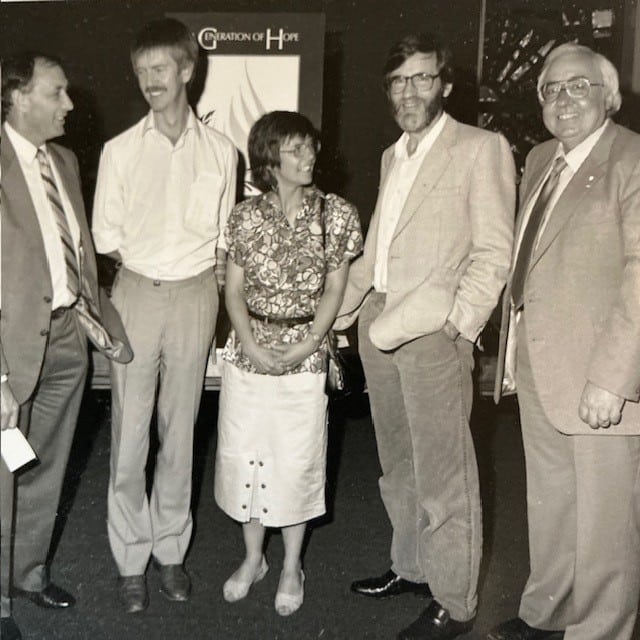
ACFID is very sad to share the news that a wonderful human rights advocate and Life Member of ACFOA, Pat Walsh AM, died on 29 December 2025. Pat worked for what was then ACFOA (now ACFID) from 1985 to 2000, as the inaugural Director of the ACFOA Human Rights Office, a vibrant, if modest office, in Fitzroy’s Napier Street. From there, Pat worked miracles through his extraordinary skills, vast networks, and his strategic as well as passionate and determined approach to his advocacy for human rights.
Before joining ACFOA, Pat had been active on both East Timor and Indonesia issues with support from a small number of member agencies and ACFOA, and worked with John Waddingham on several important reports, among them Aid and East Timor which documented the 1974 famine in East Timor to which ACFOA had responded with a team led by David Scott. It was in this period that Pat was a major contributor to ACFOA’s first ever Development Dossier, ‘East Timor Today’ (1980) a critically important publication to document the death toll, famine, refugee situation and repression in the territory . One of Pat’s contributions on the politics of aid drew attention to how, of the only two aid organisations allowed in, ICRC had been severely compromised in its East Timor programme and the US organisation, Catholic Relief Services, was playing a ‘subservient role’ to the US and Indonesian governments. Pat and John also established the Inside Indonesia magazine showing early on their commitment to Indonesia as well as what became Timor Leste.
Pat’s work was influential in so many ways, but most particularly in maintaining an international NGO and activist campaign to support Timor Leste’s right to self determination through periods when the odds against it ever happening seemed unimaginably high. Advocacy for East Timor ‘s right to self-determination was often contentious within ACFOA, as the Australian government had thrown its weight behind Indonesia’s rule over the territory and this issue was an irritant in the NGO-government relationship, especially for member agencies with programs in Indonesia. But Pat’s determination and creativity found ways to move the campaign forward.
Pat’s international civil society networks were huge and influential and he used important UN and other human rights meetings to advance East Timor’s cause, as well as a multitude of other channels, such as journalists, academics and MPs, to push for change. The eventual success of the Timor solidarity work, to which Pat made a critical contribution, culminated when Pat himself was one of two ACFOA delegates on the Australian Government official election monitoring delegation led by then Deputy Prime Minister Tim Fisher, at the self-determination ballot in 1999. When East Timor was trashed by departing Indonesian troops and militia after the result of the 1999 ballot was announced, Pat made a massive effort to locate the NGO people he knew – who had fled or been forcibly removed to other parts of Indonesia – Kupang, Bali, Jakarta and Yogyakarta – and to ensure they and their families were safe. This deep care about the people who were advocating for human rights in their own countries was a mark of Pat’s work. At the same time, he launched a massive campaign to an APEC meeting gathered in New Zealand for international intervention in East Timor, which led to INTERFET.
Achieving this turn-round in Australian government policy towards East Timor was a significant tribute to Pat and his quiet but highly effective human rights diplomacy. He is highly regarded by the Timor Leste leadership, especially by President Jose Ramos Horta, and was awarded the Ordem de Timor-Leste, the country’s highest honour, in recognition of his contribution.
As Timor Leste transitioned to Independence, Pat initially helped local NGOs, especially the East Timor NGO Forum (FONGTIL), re-establish, and went on to make a major contribution in the new nation through his research leadership of the Reception, Truth and Reconciliation Commission and as one of the principal authors of the Chega! Report which documents in great detail the terrible period in Timor Leste from 1974 to 1999. He ensured the report was translated into Indonesian and promulgated in Indonesia so that Indonesians could finally get to know what had occurred there and that the history was recorded in Timor-Leste itself through the National Chega Centre for future generations.
Ironically, by establishing the ACFOA Human Rights office in 1985, a concept he credits to Bill Armstrong, Pat said,
“…the idea was to take the spotlight off East Timor by including it with a bunch of other pressing regional human rights issues. Along with East Timor, these included Burma, Sri Lanka, Indonesia and West Papua. This step was also taken to make more explicit East Timor’s status as a human rights issue, to mainstream it, as it were, and have it seen as greater than a fading single political issue on life support.”
Pat took that idea forward with enormous success, using human rights as the frame for all his work, and networked with a large regional network of international human rights advocates, He built up and mentored a team of co-workers, some volunteers, and others who were supported by project funds that Pat or small groups of ACFOA agencies raised. John Ball and Marc Purcell were among them, working on Sri Lanka and Burma issues respectively. Together they took ACFOA members’ understanding of and commitment to human rights as a development issue to a whole new level and embedded ACFOA within a regional network of human rights advocates.
Pat’s contacts in the church at Jayapura were central to campaigning on West Papua, another sensitive issue given the politics of Australia’s relationship with Indonesia. ACFOA created controversy when in 1995 it released a report on human rights violations there associated with the Freeport Mine. Subsequently Pat organised a small workshop in Canberra enabling international human rights agencies and West Papuan human rights workers to come together to strengthen their campaign. But this work sat within a much broader relationship with NGOs in Indonesia. Pat built a close relationship between ACFOA and INFID, the International NGO Forum for Indonesian Development, at that time unable to meet in Indonesia. This relationship building work supporting Indonesian civil society in their quest for democracy and human rights, was bolstered by a project auspiced by the Australian Government and BAPPENAS, called the Indonesia-Australia Program of Cooperation (IAPC). This program of officially sanctioned visits about development enabled ACFOA to engage in deeper dialogue with Indonesian NGOs. As a mark of how good the relationship had become, in 1996 INFID’s annual conference was hosted by ACFOA in Canberra. All this was greatly enhanced by Pat’s extraordinary gift for building relationships and networks and gently but persistently working towards his long-term vision of respect for human rights across the region. Pat always had support in this regional human rights work from ACFOA leaders such as Bill Armstrong, Sir Ronald Wilson and the late Jeremy Hobbs.
Pat often worked within the UN and its human rights structures to advance regional human rights. UN engagement gave legitimacy to his human rights approach to development across a broad spectrum of member agencies as well as governments. Among many other things, he ensured three young Timorese women could participate in the UN World Women’s Conference in Nairobi in 1985, Mimi Ferreira, Ines de Almeida and Emilia Pires, a formative experience for them. Pat himself participated in the 1993 UN World Conference on Human Rights in Vienna using that event to build his regional networks among democracy and human rights movements across Asia and work with them to counter a prevalent Asian government view that “Asian values”, not universal human rights, were all that was needed. That very significant conference confirmed that human rights were indivisible and universal.
Pat made important contributions to a number of other NGOs, among them the Diplomacy Training Program and the Australian Human Rights Council, and leaves a wonderful legacy of writings – he was a terrific researcher and a great observer of people, bringing to everything his delightful chuckle and wry sense of humour as well as laser sharp analysis and strategic wisdom.
He also leaves a beautiful family, his wife Annie, their three daughters Mayra, Suzannah and Patricia, and seven grandchildren, and the Timor Leste connection continues through the generations.
ACFID extends its condolences to them and to Pat’s extended family and many friends throughout the region.
Pat’s website where many of his publications can be found is: https://patwalsh.net/
His funeral will be held on Tuesday 13 January at 11am at St Joseph’s Catholic Church, 140 Westbourne Grove, Northcote. A memorial wake will follow at the Peacock Inn Hotel 210 High Street, Northcote with some speeches, poetry and music. The funeral will be Webcast via Tobin Brothers Funerals.